I was living in Taiz, in a community exhausted by years of conflict, where disagreements and misunderstandings had accumulated between different parties. I was working with young people and taking part in community initiatives, but I could see that enthusiasm alone was not enough to build peace, and that some disputes became more complicated when people could not find someone willing to listen to them fairly.
Since joining the Youth Mediation Team in February 2025, I have taken part in field conflict assessments, dialogue facilitation, and communication with local authorities and community leaders to support peaceful solutions. During one experience, I found myself facing a community tension that threatened to deepen mistrust between local parties. The conversations were tense, and each side believed that it had not been properly heard.
I began by trying to understand the conflict before thinking about how to solve it. I listened to the parties separately and made sure that each side had an equal opportunity to explain its position, needs, and fears. I did not begin by asking, “Who is wrong?” Instead, I asked: “What happened? And what does each side need for dialogue to become possible?”
I then helped create a space for dialogue based on respect and listening without interruption. Gradually, the conversation began to move away from accusations and toward shared interests. The moment I will never forget was when one of the parties began truly listening instead of simply preparing to respond. That was when I realized that a mediator’s role is not to impose a ready-made solution, but to help people build a path they can walk together.
The process was not easy. Building trust was the hardest part, especially in an environment where each side felt that it was the one that had been harmed. But I learned not to measure the success of mediation only by how quickly an agreement is reached. Sometimes success means keeping the door to communication open and helping people move one step closer to understanding. I kept reminding myself: “I am not here to choose a side. I am here to protect a space where everyone can speak and listen without fear.”
Mediation changed me before I could contribute to changing others. I began to listen more, judge less, and look for common ground even when it seemed limited. I also realized that the presence of young people in mediation spaces presents a different image of their role: they are not simply recipients of peace, but partners who can build trust and bring different perspectives closer together.
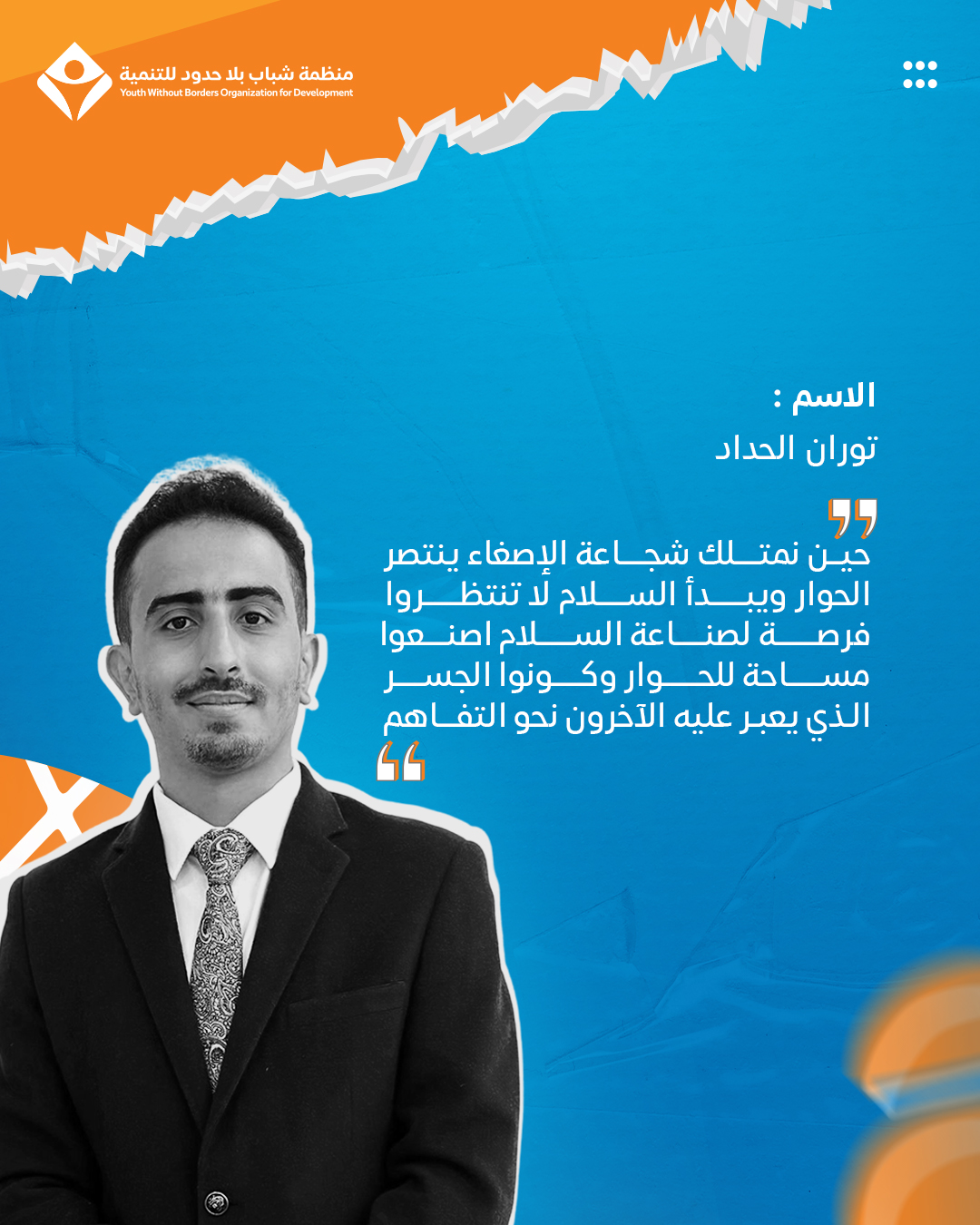
My message to every young person is: Do not wait for an opportunity to make peace. Create a space for dialogue, and become the bridge that others can cross toward understanding.
When we have the courage to listen, dialogue prevails and peace begins.